

There are careers in America capable of producing extraordinary incomes.
But there's another side of the equation that career seekers don't always consider.
What does it take to get there?
How many years will you spend in school?
How much will the education cost?
How much student debt could you accumulate?
How long before you're actually established in your profession?
And most importantly...
IS THERE ANOTHER PATH?
For the right person, there may be.
Welcome to the world of Financial Services.
A profession where certain career paths can begin with licensing and professional training rather than medical school—and where advancement can depend heavily on your ability to learn, serve clients, build relationships, produce results and, in some business models, build a business.

There's a reason America's most highly compensated medical professionals
command extraordinary incomes.
They earned it.
Their careers can require:
➤ Years of undergraduate education
➤ Medical or professional school
➤ Residency
➤ Specialty training
➤ Fellowships for certain specialties
➤ Board examinations and licensing
➤ Continuing education
➤ Enormous personal commitment
➤ Delayed entry into full professional practice
For someone passionate about medicine, that investment can absolutely make sense.
But what if your primary objective is different?
What if you're searching for a career with a substantially shorter educational runway?
That's where this comparison becomes interesting.

Think about those numbers.
Before considering specialty income,
a future physician may have already committed
years of life and hundreds of thousands of dollars toward education.
That doesn't make medicine a bad career.
It demonstrates the 'enormous investment required' to enter it.
Now compare that with another path.

THE CAREER TIMELINE
Medical Specialist Path: High School ➤ 4 Years College ➤ 4 Years Medical School ➤ Residency ➤ Possible Fellowship/Specialty Training ➤ Specialist Career. This path can involve 10–15+ years of education and training, substantial tuition costs, potential six-figure student debt, professional examinations, licensing requirements, and years before reaching independent specialty practice.
Financial Services Path: High School / College / Prior Career ➤ Prepare ➤ Pass Required Insurance Exam(s) ➤ State Licensing ➤ Company and Field Training ➤ Begin Building Your Career. Those expanding into securities may follow: SIE ➤ Firm Association/Sponsorship Where Required➤ Appropriate FINRA Qualification Exam ➤ Registration. Financial services generally offers a much lower educational barrier and faster path to entry, but licensing does not guarantee clients, income, advancement, or success.
TWO CAREER PATHS. TWO VERY DIFFERENT ENTRY BARRIERS.
DON'T JUST COMPARE INCOME. COMPARE THE TIME, EDUCATION, DEBT, LICENSING, TRAINING AND OPPORTUNITY REQUIRED TO PURSUE IT.

According to the U.S. Bureau of Labor Statistics,
insurance sales agents typically need a:
HIGH SCHOOL DIPLOMA OR EQUIVALENT
Agents must also obtain the appropriate licenses
required by the states where they work.
That creates a fundamentally different career-entry equation.
Instead of asking...
“What graduate degree do I need?”
You may be asking...
“What licenses do I need, what must I learn,
and how quickly can I become competent enough
to serve clients professionally?”
That's an entirely different conversation.

FINRA's Securities Industry Essentials—or SIE
—Exam is an introductory examination
for prospective securities professionals.
You don't need to be associated with
a securities firm simply to take the SIE.
FINRA currently lists the exam as:
➤ 75 questions
➤ 1 hour 45 minutes
➤ $100 examination fee
➤ Available to individuals age 18+
➤ No firm association required to take the SIE
However, passing the SIE does not by itself authorize
someone to conduct securities business.
Registration requires the appropriate representative-
level qualification examination
and applicable firm association.
For example, a Series 7 candidate must pass
both the SIE and Series 7 for General Securities
Representative registration, and the Series 7 requires
association/sponsorship by a FINRA
member or other applicable SRO member firm.
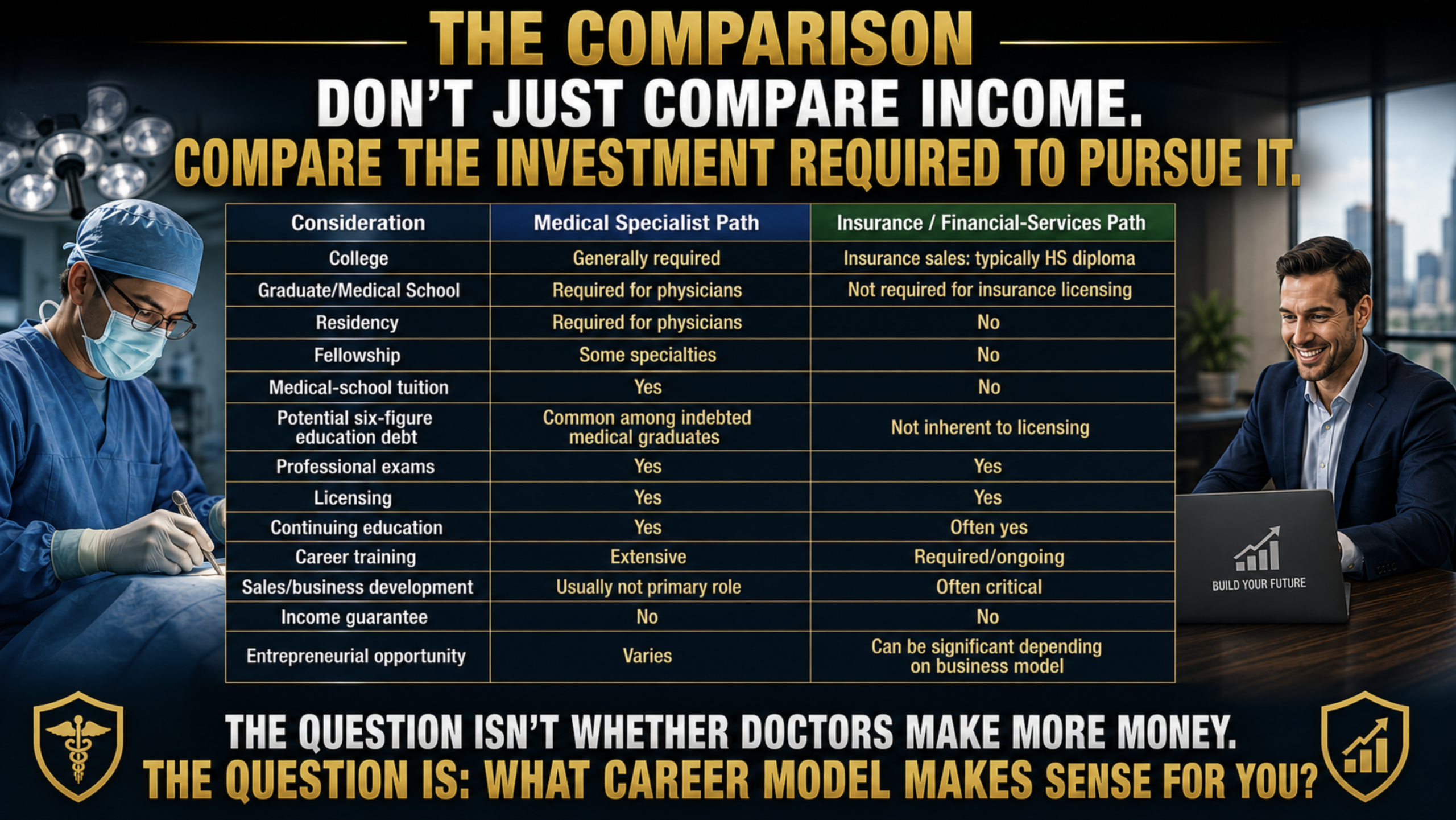
DON’T JUST COMPARE INCOME. COMPARE THE INVESTMENT REQUIRED TO PURSUE IT.
When comparing careers, look beyond the paycheck.
Consider the education, time, tuition,
potential student debt, examinations,
licensing, training, and years required
to enter the profession.
Many high-paying medical specialties
require college ➤ medical school ➤
residency ➤ possible fellowship,
while financial services can offer
a more accessible pathway
through professional licensing
➤ training ➤ client development
➤ advancement ➤ leadership
➤ business building.
Neither career guarantees income or success,
but the time and financial barriers
to entry can be dramatically different.
The real question isn't simply,
“Which career pays more?”
The better question is:
“Considering the time, education,
debt, training, opportunity and career model
—WHICH PATH MAKES THE MOST SENSE FOR ME?”

Maybe you've been asking the wrong question.
Instead of:
“What's the highest-paying job I can get?”
Consider asking:
“Where can my skills, work ethic, leadership ability
and willingness to learn create
the greatest long-term opportunity?”
That's a very different question.
Because in many performance-driven careers,
you're not simply being paid for occupying a position.
You're being compensated for producing value.

For some people, 'a predictable salary' is exactly what they want.
For others, there's another question...
“WHAT COULD I BUILD?”
Depending upon the company and business model,
financial professionals may have opportunities to...
➤ Serve individual families
➤ Develop long-term client relationships
➤ Earn commissions or other
performance-based compensation
➤ Build recurring client relationships
➤ Develop specialized markets
➤ Build referral networks
➤ Become licensed in additional areas
➤ Develop leadership skills
➤ Train or mentor other professionals
➤ Potentially build an independent
or entrepreneurial practice
Compensation structures, ownership rights and
advancement opportunities vary
substantially by company and role.

Yes—but possibility is not the same thing as a promise.
BLS reports that securities,
commodities and financial-services
sales agents had median annual pay
of approximately $78,660 in 2025.
Insurance sales agents had median
annual pay of approximately $62,280.
And performance varies enormously.
Income can depend upon...
Licensing • Role • Company • Market
• Experience • Production • Clients •
Compensation Structure •
Leadership • Persistence
This is not a get-rich-quick opportunity.
And that's precisely why the opportunity
deserves to be presented professionally.

Imagine two people starting today.
One commits to a profession 'requiring
years of formal education' before
reaching independent professional practice.
The other enters a 'licensed,
performance-driven profession'
and begins developing clients, knowledge,
communication skills, leadership skills
and professional experience much earlier.
Neither person is guaranteed success.
Neither path is automatically superior.
But after ten years...
THEIR CAREER JOURNEYS
COULD LOOK RADICALLY DIFFERENT
So before choosing your next career
based exclusively on a salary chart…
Compare The Entire Journey!




WHO WE ARE!
Got More Questions?
We Have The Answers!
Just Fill In The Form Below
Press SUBMIT And We
Will Contact You Shortly
Click On The Stack of Brochures Below
To Access Your FREE Copy!

HIGH PAYING JOBS | MORTGAGE PROTECTION INSURANCE | STEVEN L HODGE | TEXAS BEST LIFE INSURANCE | TEXAS BEST LIFE | FINAL EXPENSE BURIAL INSURANCE | WE DO ROLLOVERS | FIXED INDEX ANNUITY | HOW MONEY WORKS FOR WOMEN | HIGH YIELD INTEREST SAVINGS ACCOUNT | WE NEED LEADERS | TERM LIFE INSURANCE
TODAY'S CHILD TOMORROW'S MILLIONAIRE | CHILD LIFE INSURANCE | CERTIFIED FINANCIAL ADVISOR | CERTIFIED FINANCIAL PLANNING | WORK FROM HOME JOBS | 6 FIGURE CAREER | TEACH IT FORWARD | HIGH YIELD SAVINGS ACCOUNT | CAREER FAIR NEAR ME | WEALTHWAVE | TIC TAC DOUGH | LONGTERM CARE INSURANCE | TRUSTS AND WILLS | SPECIAL NEEDS TRUST | TAX DEBT RELIEF | FINANCIAL NEEDS ANALYSIS | FINANCIAL EDUCATORS NEEDED | BUSINESS SUCCESSION PLANNING | ESTATE PLANNING | 7 MONEY MILESTONES | INDEXED UNIVERSAL LIFE INSURANCE | FINANCIAL LITERACY WORKSHOP | HOW MONEY WORKS | ANNUITIES EXPLAINED | BEST CD RATES | TOMORROWS PEACE | NATIONAL DEBT RELIEF | 401(K) ROLLOVER WEBINAR | FINANCIAL SERVICES MASTERCLASS | RETIREMENT PLANNING | FINAL EXPENSE INSURANCE |
2026 © Copyright | HIGH PAYING JOBS | All Rights Reserved.
Your privacy is of utmost importance to us. At HIGH PAYING JOBS, we are committed to protecting the personal information you provide. View our Privacy Statement which outlines the types of information we collect, how it is used, and the measures we take to ensure your data remains confidential and secure.